Skip to content

studentdeveloperAI researcherhacker

Albus Xiao

I build experimental software and take systems apart to see how they think. This is my lab — prototypes, research notes, and a few ideas still being debugged.

Build 13dd25c

01about

I like understanding systems well enough to build strange new ones.

Hi — I’m Albus. I’m a student and developer who likes understanding systems all the way down: how the pieces fit, where they fail, and what happens when you connect them in ways nobody planned for.

Most of what I build starts as a question. Can ChatGPT and Claude Code work together as collaborators? Can an assistant turn my schedule, reminders and stray ideas into one useful briefing? Can an AI system learn what to ignore? Can you actually watch a network learn? Some questions become projects, some become notes, and a few become lessons about what not to do.

I’m drawn to AI systems, software engineering, research and hackathons — anywhere a weird idea can get a fast prototype and an honest test. At Sundai’s Hack 148 the test was whether a behaviour model could guess which headlines people click. Partly — popularity still won.

02projects

Systems in progress, and experiments on the bench.

5 projects · 3 featured
3 modules

P-01build

Status: experimental

ORBITAL

Coordinating AI coding environments as collaborators.

An experimental system for coordinating AI coding environments, with a focus on collaboration between ChatGPT and Claude Code. It’s a testbed for AI-driven software development workflows and the orchestration they need.

stage
Early days: so far the repository holds the ground rules its AI collaborators work under — what they may and may not do with Git, tests and temporary files. The orchestration code isn’t published yet.
explores
  • AI-driven software development workflows
  • Orchestration across AI coding environments
  • ChatGPT ↔ Claude Code collaboration

fig. 01

concept sketch · interactive

inspect a node to see its role
Concept sketch — one coordination layer, several AI coding environments.

P-02build

Status: paused

Lisa

A personal AI secretary, designed around the Apple ecosystem.

An experimental personal AI secretary for one owner. It reads the calendars, forwarded email and news it’s given, plans the day around commitments and ideas, follows up with reminders and writes a morning brief — with a Mac as its host and the iPhone and iPad as companions.

stage
Paused after phase 4 of its first release. The portable Swift engine — calendar, mail and feed parsing, planning, reminders, briefing and storage — is implemented and checked on Linux; the runtime, live integrations and the Apple apps are still to come.
explores
  • A morning brief grounded in calendars, mail and news
  • Turning commitments into a daily plan and reminders
  • Keeping inbound content and model output behind strict trust boundaries
stack
  • Swift 6
  • SQLite
  • libxml2

fig. 02

concept sketch · interactive

single owner

inspect a node to see its role

Concept sketch — what Lisa reads, and what comes back out.

R-01research track

Status: research

Teach AI What to Ignore

Selective attention for persistent AI systems.

A research project on how persistent AI systems can selectively ignore irrelevant input — and invoke computationally expensive reasoning only when a meaningful signal appears.

stage
Early code: the feature stage of ACHGate, a PyTorch network — depth-wise convolutions over each input signal, then masked multi-head self-attention. Its prediction stage comes next.
explores
  • Filtering irrelevant input in always-on systems
  • Deciding when expensive reasoning is worth invoking
  • The trade-off between compute spent and signals missed
stack
  • Python
  • PyTorch

fig. 03

toy model · interactive

escalated
—
signals caught
0/0
missed
0
wasted calls
0
last 150 inputs
compute → vs signals caught ↑
at 0.50: 22% escalated, 97% caught
Toy model — a gate decides which inputs deserve deliberate reasoning. Illustrative only; these are not experimental results.

02.2 more · experiments & software

2 modules

P-03build

Status: prototype
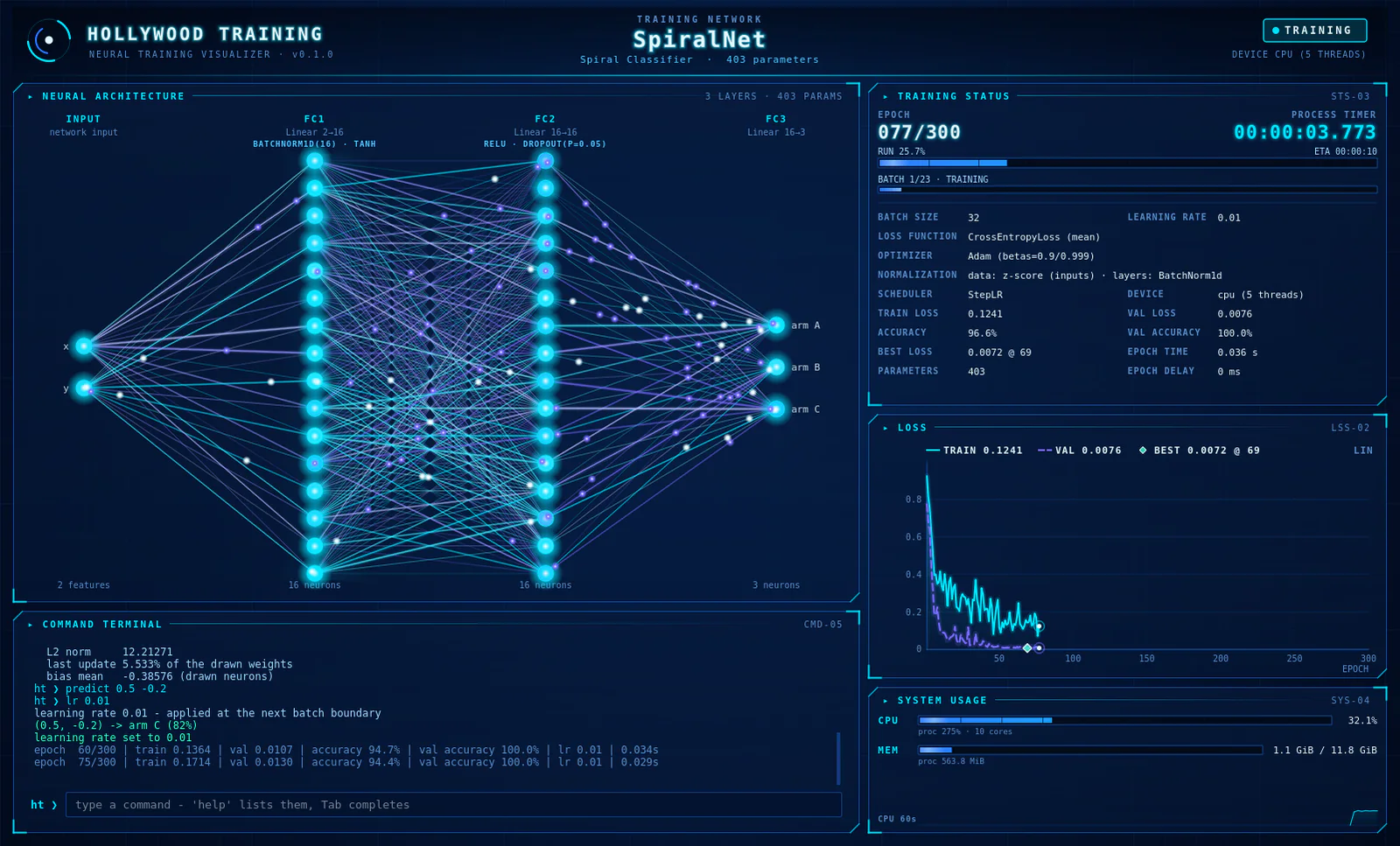
The Hollywood Training window training a spiral classifier: the network drawn from its weights, the training status, a loss chart, system usage and a command terminal.
The training window during the spiral-classifier demo: network, status, loss curve, system usage and command terminal. Screenshot from the repository.

Hollywood Training

Watch PyTorch networks train in a native, Hollywood-style window.

A training visualizer for PyTorch. Add a decorator to the model and wrap the training step, and a native Qt window shows the real network drawn from its live weights, loss curves, training status and system usage — plus a command terminal that controls the run: pause, step, change the learning rate, save. The training code stays as written.

stage
A working alpha (v0.1.0) with runnable demos, checked by a test harness written against its own requirements.
explores
  • Drawing a network from its real, changing weights
  • Keeping each epoch in step with the window without slowing training down
  • Driving a live training run entirely from the keyboard
stack
  • Python
  • PyTorch
  • PySide6 / Qt 6
  • NumPy

X-01hackathon

Status: completed

fig. 05

pipeline · interactive

inspect a node to see its role
The pipeline — readers’ earlier clicks in, BehaviorGPT’s picks out, graded against the clicks it never saw.

Distilling Significance

Can a behaviour model guess which headlines you’ll click — with zero training?

An experiment from Hack 148, Sundai’s hackathon. Readers’ earlier clicks from MIND, a real Microsoft News log, go to BehaviorGPT — Unbox AI’s pretrained behaviour model, unchanged — which picks the headlines it expects each person to open next. The picks become pseudo-labels, graded against the clicks it never saw. The honest result: it beats chance (AUC 0.58 against 0.50), but plain popularity still wins (0.66).

stage
Complete: the first study ran on 5,000 impressions, then scaled to 25,000. Method, results and a data card are in the repository; the data itself is not.
explores
  • Predicting human attention zero-shot, from click history alone
  • Pseudo-labels as cheap attention labels — and distilling them into a small student model
  • Grading against what people actually did, beside simple baselines
stack
  • Python
  • BehaviorGPT API
  • pandas
  • scikit-learn